Today’s blog poses the question “Will substituting rods for sticks cut it in the studio?”
First of all, let’s examine the options, because there are a lot of brands/models available, and they each sound unique.
I feel each drummer needs to experiment to determine what they need when recording, bearing in mind that different choices might apply in the studio compared with live performance. Live performance has different parameters, such as the need to project your sound, durability concerns, feel/rebound of each model, and so on. Many readers will already know that the wooden rods give much more rebound than the nylon rods.
My initial move into the use of rods came about in the late 1980’s, as a way of playing jazz in restaurants without getting complaints from maitre d’s. I also was given a home made pair which had a bunch of satay (kebab) sticks glued in to a plastic pipe bought from a hardware store. Whilst they had plenty of attack, along with some rebound, they were not very durable.
For those who need to familiarise, Drum.dog website has a helpful introductory demonstration of different kinds of rods and how they sound.
I now want to focus on two recordings I’ve done using rods.
The first track is an independent track I did at Chris Wilson’s studio, from the 2016 album I Live The Life I Love.
https://www.chriswilsonrecordings.com.au
This was an album dedicated to Chris’ musical influences, so this particular track was a re-working of the Chicago classic “25 or 6 To 4”. Stylistically I was going for a more acoustic-oriented sound, still funky but not as full-on as the original. So I used Pro-Mark Hot Rods on Chris’ Mapex kit, with my own Zildjian K Constantinople cymbals, and my wood shell DW snare.

Chris likes to utilise a ‘Glyn Johns” type of mic setup on drums (see link below), which relies on the drummer balancing all the parts he is playing as he lays the track down. He set up an overhead mic, and another to my right, near the floor tom, for a stereo ‘snapshot’ of the kit. Also a mic at the front of the bass drum. With this approach, there is little the engineer can do later to change the balance of the kit. This approach harks back to 1960’s recording techniques.
The Glyn Johns drum mic-ing technique is explained here –
Here is an mp3 of the result.
25 or 6 To 4
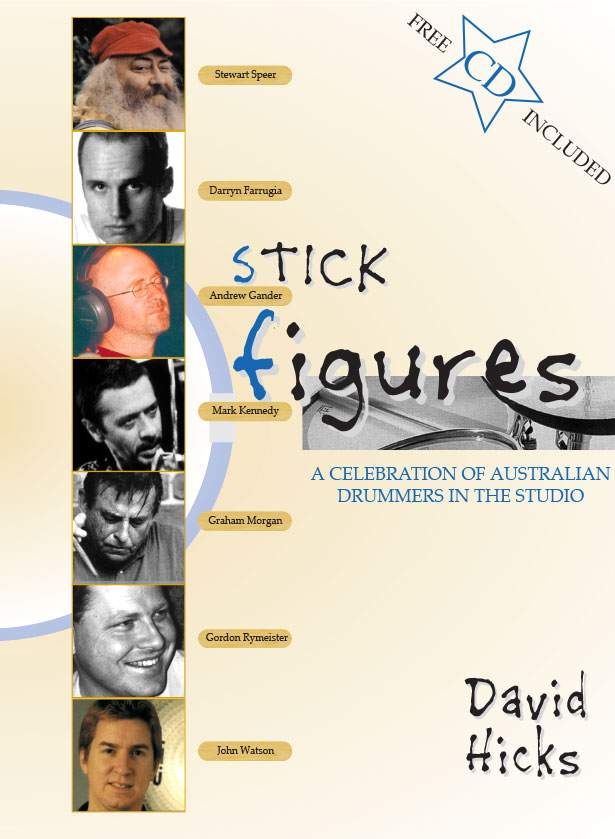
[While we’re listening to tracks from Chris’ studio, here’s one that Mark Kennedy (featured in my book Stick Figures) recorded there. He used the wooden ‘kebab’ style rods mentioned earlier. It’s worth noting that for some of his accents Mark utilised opening hi hat instead of crash cymbals, since the attack you can get on a crash cymbal from these rods is limited.]
Solid Ground
The second track I wanted to present where I recorded with rods was a Max Merritt track, “Tempted”, recorded at AAV Melbourne in 2002. I’ve examined another track from this album in an earlier blog post (“Candy Row”). Again, this was my Pearl Masters kit, with a Steve Ferrone signature model 14 x 6.5” snare (now out of production).


During pre-production rehearsals I talked Max into letting me use Regal Tip “Blastix”, with nylon ‘rods’, to give the track a different tone to the rock songs – and reflect the song’s romantic mood – whilst still making the groove strong. Since Max was a rock n roll legend, I had to back myself to win him over with such a suggestion!

I hit rimshots on the snare throughout, for a thick backbeat slap effect. Engineer Ernie Rose added a tasteful long reverb to the snare which helps it sit really well in the mix. Focusing on locking in with bassist Glenn Suckling, I decided to employ minimal fills. Just a couple of cymbal crashes and some hi hat opening to add colour. Later I enjoyed adding vocal harmonies, along with the late Enza Pantano, guitarist John Dallimore and keyboardist Norm Falvo.
Tempted
Still not sure if rods are for you?
In closing, to really inspire you, here’s a bonus example of nylon rods being used live on an ABC radio live jazz broadcast from 1986 – featuring Aussie great Virgil Donati. It’s the Allan Zavod trio, performing an original tune in three/four, “Onlie”, written by Allan. Listen to Virgil’s solo from 4:14, using Blastix. Yes, the ones that have no rebound. Incredible facility.